If there is one piece of turtle equipment you cannot skip, it is UVB lighting. It is more important than the filter, the heater, and the tank size. Without UVB, a turtle's body slowly stops being able to use calcium, and the consequences are severe, permanent, and sometimes fatal.
This guide explains what UVB actually does, why turtles specifically need it, how to choose the right bulb, where to mount it, and how to tell whether yours is still working.
What UVB Actually Does
UVB is a specific wavelength of ultraviolet light, between roughly 290 and 320 nanometres. When this light hits a turtle's skin, it triggers a chemical reaction that converts a cholesterol-like compound into vitamin D3.
Vitamin D3 is not optional. It is the hormone that allows the intestine to absorb calcium from food. Without D3, a turtle can eat all the calcium in the world and still absorb almost none of it. The calcium simply passes through the digestive tract and is excreted.
This is why UVB is not the same as heat. A heat lamp warms the turtle, which supports digestion and immune function. A UVB lamp enables calcium metabolism, which supports bone and shell health. Both are necessary, and they do different jobs.
What Happens Without UVB
Symptoms develop gradually and are easy to miss until they are severe:
- Soft or rubbery shell. The shell loses its hardness. You can press it with a finger and it flexes.
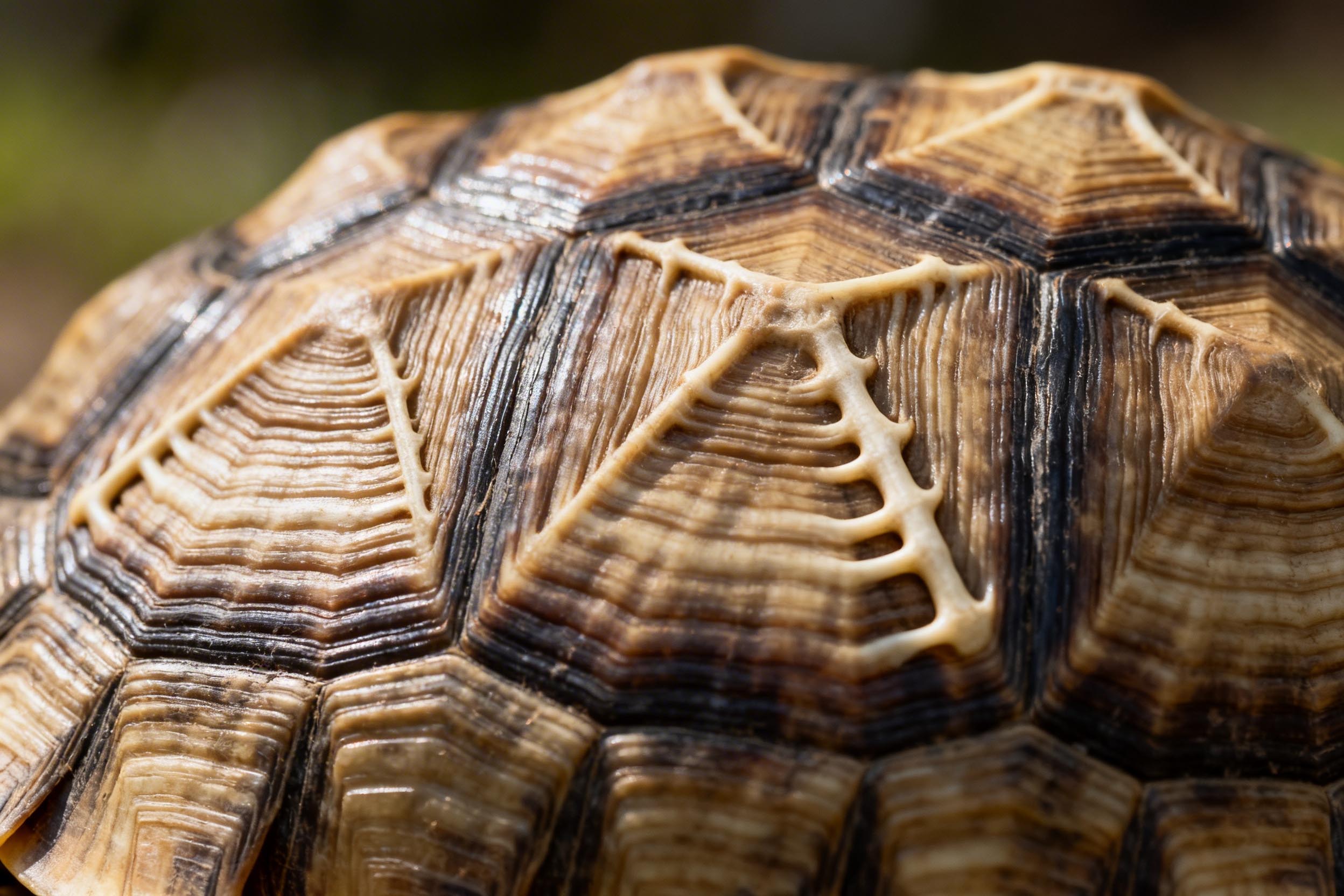
- Deformed shell shape. Pyramiding (raised scutes), curling edges, or an uneven carapace.
- Rubbery jaw. The jaw becomes soft, making it difficult for the turtle to eat.
- Weak limbs and tremors. The turtle moves awkwardly, drags its legs, or trembles.
- Loss of appetite and lethargy. Late-stage symptoms, often after significant damage has occurred.
- Fractures. Bones weakened by calcium loss break under normal movement.
Early-stage MBD can sometimes be reversed with aggressive UVB, calcium supplementation, and veterinary care. Advanced MBD is often permanent. The shell shape a turtle develops during growth cannot be corrected later — which is why proper lighting from day one is critical.
UVB vs UVA — Why You Need Both
UVB and UVA are different wavelengths of ultraviolet light, and they do different things for your turtle.
| UVA (320–400 nm) | UVB (290–320 nm) | |
|---|---|---|
| Primary role | Behaviour, appetite, colour vision, breeding | Vitamin D3 synthesis, calcium metabolism |
| Effect if missing | Lethargy, poor appetite, dull colours | Metabolic bone disease, soft shell, death |
| Can it be replaced by diet? | Partially | No — dietary D3 is unreliable in most species |
| Typical source | Most UVB bulbs also emit UVA; basking lamps emit UVA | Dedicated UVB bulbs (compact, linear, or mercury vapour) |
Most reptile UVB bulbs also emit UVA, so if you are providing a quality UVB bulb, you are covering both. But it is worth understanding the distinction — some owners assume a heat lamp or a "full spectrum" household bulb provides UVB, and it does not.
Choosing the Right UVB Bulb
There are three main types of UVB bulbs, and each has trade-offs.
Compact fluorescent (CFL) UVB bulbs: small, screw-in bulbs that fit standard fixtures. They are the cheapest option and are adequate for small enclosures. The main downside is that their UVB output is concentrated in a small area and declines faster than linear bulbs.
Linear fluorescent (T5 or T8) UVB bulbs: long tube bulbs that spread UVB across the enclosure. They are the standard for most turtle setups because they provide even coverage and last longer. T5 HO (high output) tubes are stronger than T8 tubes. If you have a large tank, a T5 linear bulb is usually the best choice.
Mercury vapour bulbs: a single bulb that provides UVB, UVA, and heat. They are powerful and simple to use. The downside is that you have less control over each element separately, and you must follow the manufacturer's mounting distance exactly.
The correct UVB strength depends on your species and mounting distance. The Ferguson Zone system is the standard reference used by reptile keepers:
| Ferguson Zone | Typical Species | Recommended UV Index |
|---|---|---|
| Zone 1 | Nocturnal or shade-dwelling reptiles (not typical turtles) | 0.6–1.4 |
| Zone 2 | Most forest and semi-aquatic turtles (box turtles, musk turtles) | 1.1–3.0 |
| Zone 3 | Partial-sun baskers (red-eared sliders, painted turtles) | 2.9–7.4 |
| Zone 4 | Desert and full-sun species (sulcata tortoises, Hermann's tortoises) | 4.5–9.5 |
Most pet aquatic and semi-aquatic turtles fall into Zone 2 or Zone 3. A 5.0 bulb mounted at 20 to 30 cm is typically adequate for Zone 2 species. A 10.0 bulb is more appropriate for Zone 3 and Zone 4 species or for setups where the bulb is mounted further away.
Mounting Distance and Mesh Covers
UVB output drops quickly with distance. A bulb that produces strong UVB at 20 cm may produce almost none at 60 cm. The manufacturer's distance guide is the only reliable reference — never guess.
Mesh and screen tops are a major problem. A fine mesh screen can block 30% to 50% of the UVB a bulb emits. If your turtle's enclosure has a screen lid and you cannot remove it, you need to either:
- Mount the bulb closer to the basking surface, or
- Use a stronger bulb (10.0 instead of 5.0), or
- Replace the mesh with a wider-gauge screen, or
- Cut a hole in the screen where the bulb shines through
Glass and plastic block virtually all UVB. Never place a UVB bulb behind glass or acrylic, and never rely on sunlight passing through a window. UVB does not penetrate these materials.
Position the bulb directly over the basking area. The turtle needs to receive UVB while it is basking, because that is when its skin is dry and exposed. A UVB bulb off to the side, or mounted over the water instead of over the dock, does little good.
If you want to verify your setup, a Solarmeter 6.5 or 6.5R measures UV Index directly at the basking surface. It is an expensive tool, but for serious keepers it removes all guesswork and tells you exactly when to replace a bulb.
Lighting Schedule and Replacement
Turtles need a consistent day-night cycle to regulate their behaviour and metabolism. Use a timer to keep the schedule stable.
- UVB + heat lamps on: 10 to 12 hours per day
- UVB + heat lamps off: 12 to 14 hours per day (nighttime)
Do not leave UVB on 24 hours a day. Constant light disrupts sleep, suppresses immune function, and causes stress. If you need nighttime heat (for tropical species), use a ceramic heat emitter or a deep heat projector that emits no visible light.
Linear T5 HO bulbs generally last 9 to 12 months. Compact fluorescent bulbs often decline in 6 to 9 months. Mercury vapour bulbs typically last around 12 months but should still be checked with a meter if you have one.
Can Real Sunlight Replace UVB Bulbs?
Real, unfiltered sunlight is the best possible UVB source — better than any artificial bulb. If you can safely provide outdoor time in a protected enclosure, it is excellent for your turtle's health.
But there are several important caveats:
- Direct sun only. Sunlight passing through window glass, plastic, or acrylic provides no UVB. A turtle basking behind a window is getting heat and visible light, but no UVB.
- Shade must be available. Turtles cannot regulate UVB exposure the way they regulate heat. Provide a shaded area so the turtle can retreat if it wants to.
- Predator protection. Outdoor enclosures must be secure from birds, raccoons, dogs, cats, and other predators.
- Escape prevention. Turtles are excellent climbers. Any outdoor enclosure must have walls tall enough and smooth enough to prevent escape.
- Weather. Do not rely on outdoor time during winter, cloudy weeks, or rainy periods. UVB bulbs are still necessary as a backup.
For most indoor keepers, a quality UVB bulb is the only reliable year-round UVB source. Real sunlight is a bonus, not a replacement.
Frequently Asked Questions
Do turtles really need UVB light?
Yes. UVB light allows a turtle's skin to synthesize vitamin D3, which is required to absorb calcium from food. Without UVB, calcium passes through the digestive system unused, and the turtle's body begins pulling calcium from its bones and shell. This leads to metabolic bone disease, soft shell, deformities, and eventually death. There is no safe substitute for UVB.
What UVB strength should I use for my turtle?
Aquatic turtles, sliders, and most semi-aquatic species do well with a 5.0 or 10.0 UVB bulb depending on the mounting distance and the mesh or screen between the bulb and the animal. Desert tortoises and species from high-UV environments generally need a 10.0. Always follow the manufacturer's distance guide — the Ferguson Zone chart is the standard reference.
How far should the UVB bulb be from my turtle?
It depends on the bulb's output. A typical compact 5.0 bulb works at 20 to 30 cm (8 to 12 inches) from the basking surface. A 10.0 bulb usually works at 30 to 40 cm (12 to 16 inches). Mesh or screen tops block 30 to 50% of UVB, so if you have a screen, mount the bulb closer or use a stronger bulb. Always verify with a Solarmeter if possible.
How often should I replace a UVB bulb?
Every 6 to 12 months, even if the bulb still lights up. UVB output decays long before visible light output. A bulb that appears bright to your eyes may be emitting almost no UVB. Mark the replacement date on your calendar. Compact fluorescent and linear fluorescent bulbs typically need replacement every 6 to 9 months, while mercury vapour bulbs often last 12 months.
Can I use a regular household bulb instead of a UVB bulb?
No. Regular incandescent, halogen, and LED bulbs emit no meaningful UVB. They can provide heat, but they cannot replace a reptile-specific UVB bulb. Some "full spectrum" bulbs sold for humans emit UVA but no UVB and are equally useless for calcium metabolism.
Can I use a UVB bulb designed for reptiles other than turtles?
Yes, as long as the UVB output is appropriate for your turtle's needs. Bulbs marketed for bearded dragons, iguanas, and tortoises are generally fine. Avoid UVB bulbs designed for tropical reptiles that require very low UVB — those will be insufficient for a turtle.
Final Thoughts
UVB lighting is the single most important piece of equipment in a turtle enclosure. It is not optional, it is not replaceable with diet, and it is not something you can skip "just for a while." Calcium metabolism depends on it, and calcium metabolism depends on everything else — shell strength, bone density, growth, reproduction, and immune function.
If you take only one thing from this article: buy a proper UVB bulb, mount it correctly, and replace it every 6 to 12 months. That single habit will prevent the most common and most devastating disease in captive turtles.
For more on turtle setup, see our complete diet guide and our red-eared slider care guide.
Sources & References
- Mader, D. R. (2005). Reptile Medicine and Surgery (2nd ed.). Saunders Elsevier.
- Baines, F. M. (2016). How to interpret the UVB lamp output. Journal of Herpetological Medicine and Surgery, 26(1-2).
- Ferguson, G. W., et al. (2010). Voluntary exposure of some western-hemisphere snake and lizard species to ultraviolet-B radiation in the field: how much ultraviolet-B should a lizard or snake receive in captivity? Zoo Biology, 29(3), 317–334.
- Merck Veterinary Manual. Management and Husbandry of Reptiles. Retrieved 2026.
- Association of Reptilian and Amphibian Veterinarians (ARAV). Lighting and metabolic bone disease in reptiles. Retrieved 2026.
- Girling, S. J., & Raiti, P. (2004). BSAVA Manual of Reptiles (2nd ed.). British Small Animal Veterinary Association.