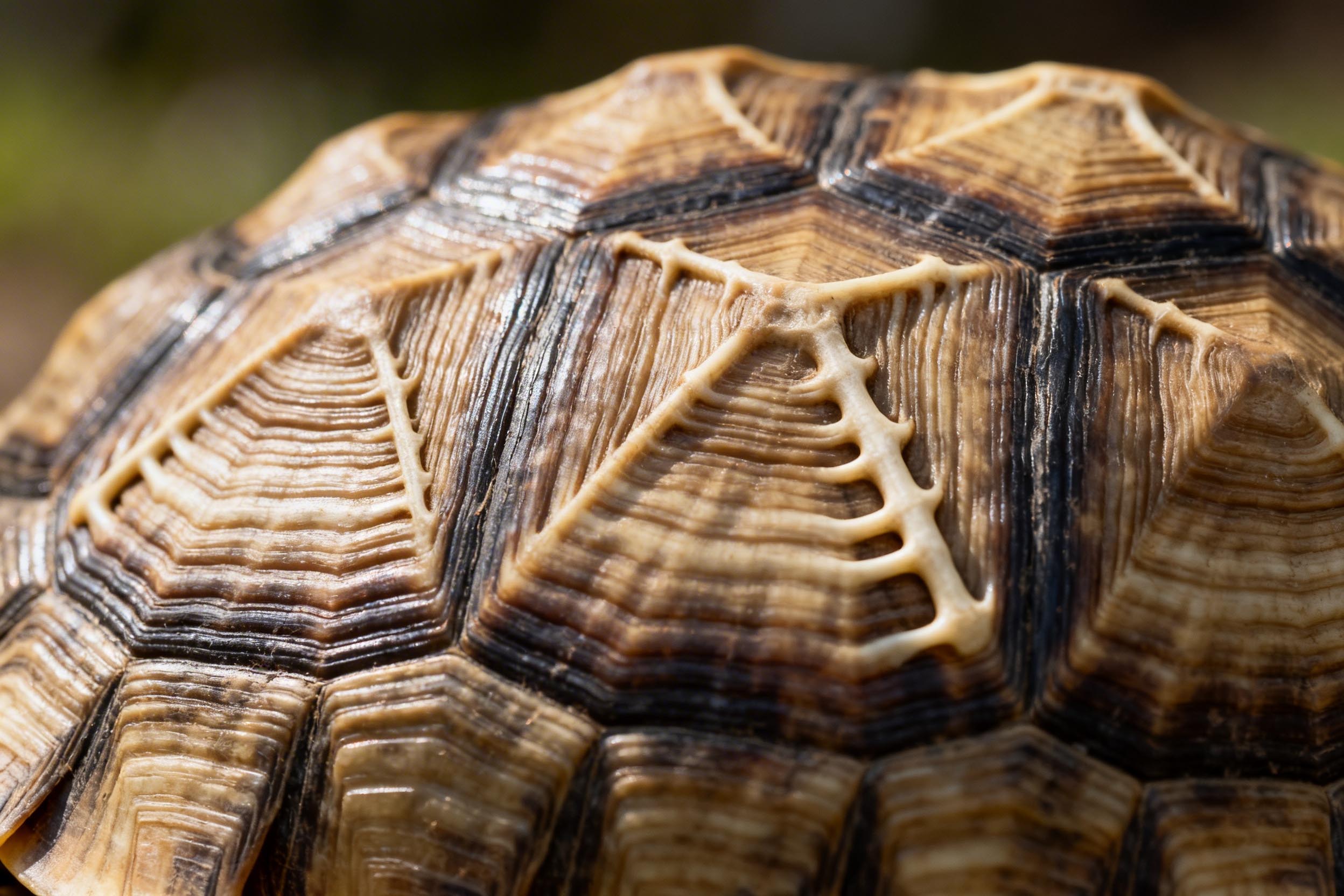
It is one of the most common misconceptions in turtle keeping: the idea that the shell is a dead, hard covering that the turtle cannot feel. This myth has led to real harm — keepers tapping on shells to "test" them, children poking turtles at petting zoos, and even people drilling or gluing things onto shells.
The truth is simple: the shell is living bone, and it has nerves. A turtle can feel everything that happens to its shell, from a light touch to a serious injury.
Why the Shell Has Nerves
To understand why turtles feel pain in their shell, you have to understand what the shell actually is. It is not a separate structure that the turtle carries around. It is the turtle's ribcage and spine, fused together and grown outward.
The shell has two layers:
- The outer layer — keratin scutes. These are made of the same material as human fingernails and hair. They have no nerve endings and no blood supply. They are dead tissue.
- The inner layer — living bone. This is the turtle's actual skeleton, and like any bone in any animal, it is supplied with blood vessels and nerve endings.
When you touch the shell, you are touching the dead keratin scutes first. But the pressure is transmitted through to the living bone underneath, and the turtle feels it. This is why a turtle reacts to a gentle tap — it is not reacting to the touch on the scutes, it is reacting to the pressure on the bone.
What Turtles Can Feel
Turtles can perceive several types of sensation through their shell:
- Pressure. A light touch is felt as a gentle pressure. A firm tap is felt as a sharper sensation. Turtles often react to even gentle touches, especially near the shell edges where the bone is thinner.
- Pain. A crack, burn, or deep cut in the shell is extremely painful. The bone underneath is as sensitive as any other bone in the animal kingdom.
- Temperature. Turtles can feel heat and cold through the shell. This is why basking is so important — they are not just warming their bodies, they are warming the shell itself.
- Vibration. The shell acts as a large resonator, picking up low-frequency vibrations from the ground. This is part of how turtles sense their environment.
What turtles cannot feel through the shell: the outer keratin scutes themselves. Trimming or filing the edges of the scutes does not cause pain, as long as you do not cut into the living tissue below.
How Painful Is a Shell Injury?
To understand how painful a shell injury is, imagine a broken rib. Now imagine that rib is exposed to the outside environment, without muscle or skin to protect it. That is roughly what a cracked shell feels like to a turtle.
Shell injuries are not just painful — they are dangerous. The shell protects the turtle's internal organs, including the lungs, heart, and intestines. A deep crack can expose these organs to infection. Even a small crack can allow bacteria to enter the bone, causing osteomyelitis — a serious bone infection that is difficult to treat.
Signs that a turtle is in pain from a shell injury:
- Reluctance to move or basking constantly
- Loss of appetite
- Flinching when the shell is touched
- Swelling or discharge around the injured area
- Lethargy or unusual hiding behavior
Turtles are stoic animals and often hide signs of pain until the injury is severe. If you suspect a shell injury, do not wait — see a vet.
How to Handle a Turtle Without Causing Pain
Knowing that turtles feel pain in their shell changes how you should handle them:
- Support the plastron (bottom shell). Place one hand under the turtle's belly, not on top of the shell. This distributes the weight and avoids putting pressure on the spine.
- Never lift by the shell edges. The edges are thinner and more sensitive. Lifting by the edges can cause pain and even crack the shell in large turtles.
- Do not tap or knock on the shell. Even a gentle tap is felt. Repeated tapping causes chronic stress and can lead to illness.
- Keep handling short. Turtles are not cuddly pets. They tolerate handling, but prolonged handling causes stress. Keep sessions brief and calm.
- Never drill, paint, or glue anything onto the shell. This is painful, can introduce infection, and in some cases is fatal.
- Supervise children. Children should never be allowed to handle a turtle without adult supervision. They may tap, drop, or squeeze the shell, all of which can cause injury.
Common Myths About Turtle Shells
Myth 1: "Turtles can't feel their shell." False. The shell is living bone with nerves and blood vessels. Turtles feel pressure, pain, and temperature through it.
Myth 2: "Tapping on the shell is harmless." False. Tapping is painful and stressful. It is never a good way to interact with a turtle.
Myth 3: "A turtle can leave its shell." False. The shell is fused to the turtle's skeleton. Leaving the shell would be like a human leaving their ribcage.
Myth 4: "The shell is dead tissue." False. The outer scutes are dead keratin, but the bone underneath is living tissue, supplied with blood and nerves.
Myth 5: "Painting a turtle's shell is harmless." False. Paint blocks UVB absorption, traps bacteria, and can be toxic. It is harmful and, in many places, illegal.
Frequently Asked Questions
Do turtles feel pain in their shell?
Yes. The shell is living bone covered by keratin scutes. The bone underneath contains blood vessels and nerve endings. A turtle can feel pressure, pain, and temperature through its shell. Shell injuries are as painful to a turtle as a broken bone would be to a mammal.
Do turtle shells have nerve endings?
The outer keratin scutes have no nerve endings — like human fingernails. But the living bone underneath is richly innervated with blood vessels and nerve endings. This is why a turtle reacts to a gentle tap on the shell and why a crack or burn is extremely painful.
Can a turtle feel it when you touch its shell?
Yes. A light touch is felt as pressure, and a firm tap is felt as a distinct sensation. Turtles often react to even gentle touches on the shell, especially near the edges where the bone is thinner and more sensitive. This is one reason to handle turtles carefully and support them from underneath.
What should I do if my turtle's shell is cracked?
A cracked shell is a medical emergency. Cover the crack with a clean, damp cloth to prevent contamination, keep the turtle warm and dry, and contact a reptile veterinarian immediately. Do not attempt to repair the crack yourself — improper repair can trap bacteria and lead to infection.
Why is it bad to tap or knock on a turtle's shell?
Tapping or knocking on a turtle's shell causes pain and stress. The shell is living bone with nerve endings, so a tap is felt as a sharp sensation. Repeated tapping can cause chronic stress, which suppresses the immune system and leads to illness. Never tap on a turtle's shell, even gently.
Final Thoughts
The turtle shell is one of the most remarkable structures in the animal kingdom, but it is not armor in the way most people imagine. It is living tissue, and the turtle feels everything that happens to it. Treat it with the same care you would treat any other part of the animal's body.
Support from underneath, never tap, and never modify the shell. That is all it takes to be a respectful turtle keeper.
For more on shell health, see our shell anatomy guide and our shell rot guide.
Sources & References
- Ernst, C. H., & Lovich, J. E. (2009). Turtles of the United States and Canada (2nd ed.). Johns Hopkins University Press.
- Mader, D. R. (2005). Reptile Medicine and Surgery (2nd ed.). Saunders Elsevier.
- Wyneken, J. (2001). The Anatomy of Sea Turtles. NOAA Technical Memorandum NMFS-SEFSC-470.
- Pough, F. H., Janis, C. M., & Heiser, J. B. (2013). Vertebrate Life (9th ed.). Pearson.
- Merck Veterinary Manual. Management and Husbandry of Reptiles. Retrieved 2026.