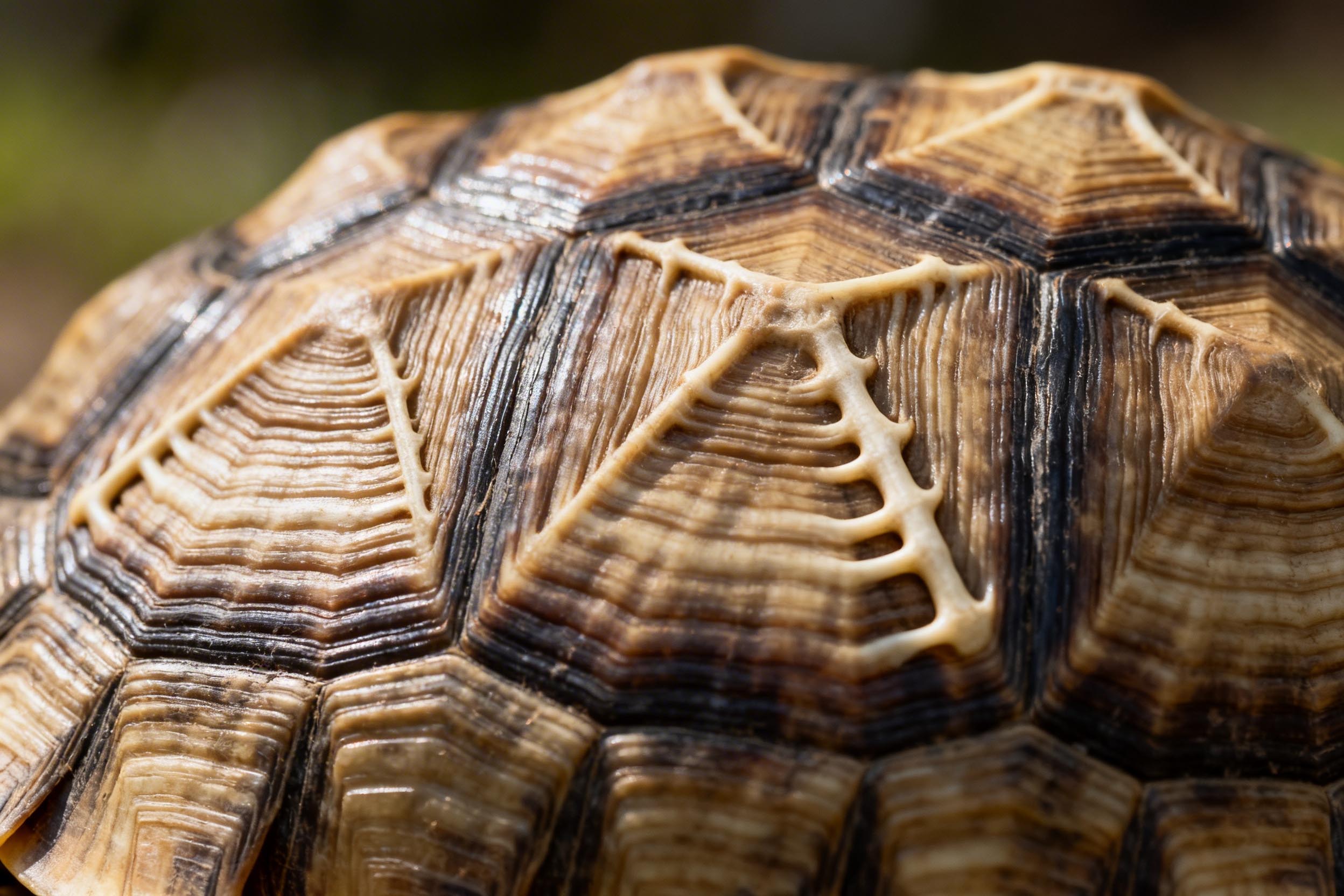
The turtle shell is one of the most recognizable structures in the animal kingdom — and one of the most misunderstood. Most people think of it as a hard outer covering, like a helmet or a house. It is not. The shell is the turtle's actual skeleton, grown outward and fused into an armored case.
This guide explains what the shell is made of, how it develops, what is inside it, and why a turtle can never, ever leave its shell.
The Shell Is Made of Fused Bones
A turtle shell is not a single bone. It is approximately 50 bones — modified ribs, vertebrae, and dermal plates — that have grown together into a rigid structure over evolutionary time.
The shell has two main parts:
- Carapace — the top shell, made from about 30 bones, including the ribs and most of the vertebrae.
- Plastron — the bottom shell, made from about 20 bones, including parts of the pelvis and dermal plates.
The carapace and plastron are connected on both sides by a bony bridge. In some species, like box turtles and musk turtles, the plastron has a hinge that allows it to close completely, enclosing the turtle's head and limbs.
The critical point: because the shell is made of the turtle's ribs and spine, the turtle cannot leave it. A turtle without its shell would be a turtle without its skeleton. This is why the idea of a turtle "leaving its shell" is biologically impossible.
Scutes: The Outer Layer
The bone of the shell is covered by a layer of scutes — hard, plate-like scales made of keratin, the same material as human fingernails and hair.
Scutes serve several functions:
- Protection. They add an extra layer of defense between the environment and the living bone.
- Waterproofing. Keratin is hydrophobic, which helps keep the shell dry and prevents water loss.
- Camouflage. Scute patterns and colors help turtles blend into their environment.
- Identification. Scute patterns are unique to each species and can be used to identify individuals.
As a turtle grows, it sheds its scutes periodically. The old scutes peel off to reveal new ones underneath. In healthy turtles, this happens gradually and the shell stays smooth. If scutes are retained (do not shed properly), the shell can become bumpy and uneven — a condition often caused by insufficient basking or poor water quality.
What's Inside a Turtle Shell
The shell is not hollow. It is filled with the turtle's internal organs, muscles, and connective tissue.
What is attached to the inside of the shell:
- Lungs. In turtles, the lungs are attached to the inside of the carapace. Because the ribs are fused and cannot expand, turtles breathe using their limbs and neck muscles to change internal pressure — see our anatomy guide for the full explanation.
- Muscles. The muscles that move the limbs, neck, and tail attach to the inside of the shell.
- Gut and organs. The digestive tract, liver, kidneys, and reproductive organs are all housed within the shell cavity.
- Heart. Like other reptiles, turtles have a three-chambered heart.
The shell is not just armor — it is the framework that supports the turtle's entire body.
The Shell Has Nerves — and Feelings
This is one of the most important things for keepers to understand: the shell has nerves.
The outer keratin scutes are dead tissue, like fingernails, and have no nerve endings. But the living bone underneath is richly supplied with blood vessels and nerve endings. A turtle can feel pressure, pain, and temperature through its shell.
This has practical implications:
- Never tap, drill, or glue anything onto a turtle's shell. It is painful and can lead to infection.
- Shell injuries are serious. A crack or burn is not like a chipped fingernail — it is like a broken bone. It requires veterinary care.
- Handle carefully. Support the plastron (bottom shell) and avoid squeezing the shell. A fall from even a short height can fracture the shell.
For more on shell health, see our shell rot guide.
How the Shell Develops
The shell begins developing in the embryo, long before the turtle hatches. The ribs grow outward and fuse together, gradually forming the carapace. At hatching, the shell is soft and slightly flexible — it hardens over the first few months of life.
In young turtles, the scutes are often raised and distinctly patterned. As the turtle grows, the scutes flatten out and the shell takes on its adult shape. Growth rings on the scutes can sometimes be used to estimate age, though this is not reliable for all species.
Proper shell development depends on:
- UVB lighting. Without UVB, the turtle cannot absorb calcium, and the shell softens and deforms. See our UVB guide.
- Calcium. A calcium-rich diet and calcium supplementation are essential for shell growth.
- Protein balance. Too much protein can cause the shell to grow too quickly and deform (pyramiding).
- Basking. Regular basking helps the shell dry and harden properly.
Frequently Asked Questions
What is a turtle shell made of?
A turtle shell is made of about 50 fused bones, including modified ribs, vertebrae, and dermal plates. The bones are covered by a layer of keratin scutes on the outside. This means the shell is not a separate structure the turtle carries — it is the turtle's actual skeleton, grown outward.
Can a turtle leave its shell?
No. The shell is fused to the turtle's spine and ribs. A turtle leaving its shell would be like a human leaving their ribcage. The shell is not a removable house — it is part of the turtle's body.
Do turtle shells have nerves?
Yes. The outer keratin scutes have no nerves, but the living bone underneath is richly supplied with blood vessels and nerve endings. A turtle can feel pressure, pain, and temperature through its shell. Shell injuries are serious and painful.
What are scutes on a turtle shell?
Scutes are the hard, plate-like scales that cover the outside of a turtle shell. They are made of keratin, the same material as human fingernails. Turtles shed scutes periodically as they grow. Retained scutes (scutes that do not shed properly) can lead to shell problems.
How many bones are in a turtle shell?
A typical turtle shell contains about 50 bones. These include the carapace (top shell), which is formed from about 30 bones, and the plastron (bottom shell), which is formed from about 20. The exact number varies by species.
Final Thoughts
The turtle shell is one of the most remarkable structures in the animal kingdom. It is not a house, not a helmet, and not a removable covering. It is the turtle's skeleton, grown outward and fused into an armored case that protects every vital organ.
Understanding the shell is essential for anyone who keeps turtles. It explains why basking matters, why UVB is not optional, why shell injuries are emergencies, and why a turtle can never — despite what cartoons suggest — leave its shell behind.
For more on turtle anatomy, see our vocal cords guide and our cloacal respiration article.
Sources & References
- Ernst, C. H., & Lovich, J. E. (2009). Turtles of the United States and Canada (2nd ed.). Johns Hopkins University Press.
- Bonin, F., Devaux, B., & Dupré, A. (2006). Turtles of the World. Johns Hopkins University Press.
- Wyneken, J. (2001). The Anatomy of Sea Turtles. NOAA Technical Memorandum NMFS-SEFSC-470.
- Pough, F. H., Janis, C. M., & Heiser, J. B. (2013). Vertebrate Life (9th ed.). Pearson.
- Merck Veterinary Manual. Management and Husbandry of Reptiles. Retrieved 2026.