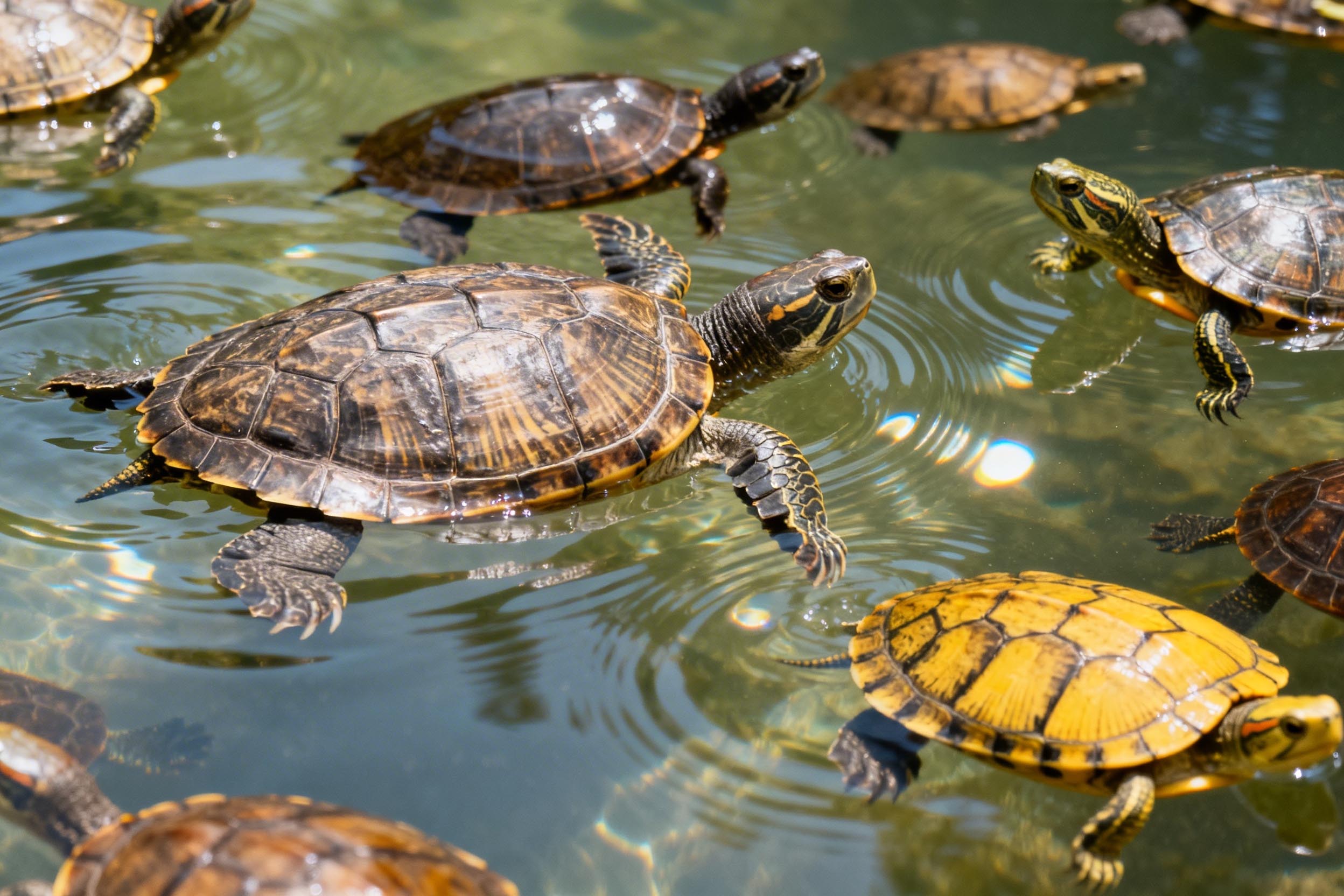
These are the two most commonly recommended tortoises for beginners — and they could not be more different. The Sulcata grows to the size of a small dog and lives for a century. The Hermann's stays the size of a dinner plate and is far more forgiving of beginner mistakes.
Choosing between them is not about which one is "better." It is about which one fits your home, your climate, and your long-term commitment.
Comparison Table at a Glance
| Attribute | Sulcata | Hermann's |
|---|---|---|
| Adult size | 60–80 cm (24–32 in) | 18–25 cm (7–10 in) |
| Weight | 50–100 kg (110–220 lb) | 2–4 kg (4–9 lb) |
| Lifespan | 50–100 years | 50–80 years |
| Enclosure | Large outdoor yard | Indoor table or small outdoor pen |
| Climate | Tropical / warm, no hibernation | Temperate, hibernates |
| Diet | High-fiber grasses and hay | Leafy greens, some grasses |
| Beginner suitability | Advanced | Excellent |
Sulcata Tortoise: The Giant
The Sulcata (Centrochelys sulcata) is the third-largest tortoise species in the world. Native to the Sahel region of Africa — the southern edge of the Sahara — it is built for a hot, dry climate and grows enormous.
Size: adults reach 60 to 80 cm and weigh 50 to 100 kg. A hatchling the size of a golf ball becomes a 100-kilogram animal in 15 to 20 years. It will outgrow any indoor enclosure long before it is fully grown.
Housing: an adult Sulcata needs a large outdoor yard with secure fencing (they are escape artists and will dig under barriers), a heated shelter for cold nights, and access to sunlight. Indoors, they need a heated room or a very large pen — not a standard terrarium.
Diet: strictly herbivorous. High-fiber grasses and hay (Bermuda, orchard, timothy) should make up the majority of the diet. Very little fruit, no protein, and careful calcium supplementation. Overfeeding protein causes shell deformities and organ damage.
Climate: Sulcatas do not hibernate. They must be kept warm year-round and cannot tolerate temperatures below 15°C. In cool climates, this means a heated indoor enclosure for much of the year.
The long-term reality: a Sulcata can live 50 to 100 years. It will likely outlive its owner. Rehoming an adult Sulcata is extremely difficult because of its size. This is not a pet to buy on impulse — see our beginner's guide for a more realistic starting point.
Hermann's Tortoise: The Beginner-Friendly Choice
The Hermann's tortoise (Testudo hermanni) is a small European species that has been kept as a pet for centuries. It is hardy, long-lived, and far more forgiving of beginner mistakes than a Sulcata.
Size: adults reach 18 to 25 cm and weigh 2 to 4 kg. This is small enough to be kept indoors in a tortoise table, or outdoors in a secure pen in a mild climate.
Housing: a 1.5 x 1 metre indoor tortoise table is adequate for an adult, with a basking lamp and UVB strip. Outdoors, a secure pen with a wire mesh floor (to prevent digging out) works well in warm weather.
Diet: herbivorous, but more varied than a Sulcata. Leafy greens (dandelion, plantain, romaine), some grasses, and occasional fruit. Calcium supplementation and UVB are essential.
Climate: Hermann's tortoises are temperate-zone animals and naturally hibernate (brumate) in winter. They can tolerate cooler temperatures than Sulcatas, though they still need warmth and UVB during the active season. See our hibernation guide for details.
The long-term reality: a Hermann's tortoise can live 50 to 80 years. It is still a multi-decade commitment, but far more manageable than a Sulcata. An adult can be comfortably housed in a small indoor enclosure, which makes it a realistic option for apartment dwellers.
Which One Should You Choose?
Choose a Hermann's tortoise if:
- You are a first-time tortoise keeper
- You live in an apartment or have limited outdoor space
- You want a tortoise you can keep indoors year-round
- You live in a temperate climate
Choose a Sulcata only if:
- You have a large, secure outdoor yard
- You live in a warm climate (or can provide a heated indoor space)
- You are prepared for a 100-kilogram animal that can live 80+ years
- You have a plan for what happens to the tortoise if you can no longer care for it
For 90% of beginners, the Hermann's tortoise is the better choice. It is more manageable, more forgiving, and still a rewarding, long-lived companion. The Sulcata is a magnificent animal, but it is a lifetime commitment that requires serious planning.
Frequently Asked Questions
Which is better for beginners, Sulcata or Hermann's tortoise?
Hermann's tortoise is far better for beginners. It stays small (18–25 cm), needs a manageable indoor or outdoor enclosure, and does not require the massive space a Sulcata eventually needs. Sulcata tortoises grow to 60–80 cm and 50–100 kg, need a large outdoor yard, and are a 50–100 year commitment that most beginners are not prepared for.
Do Sulcata tortoises hibernate?
No. Sulcata tortoises are from the Sahel region of Africa and do not hibernate. They must be kept warm year-round and cannot tolerate temperatures below 15°C. Hermann's tortoises, by contrast, are temperate-zone animals that naturally hibernate (brumate) in winter.
How big does a Sulcata tortoise get?
Sulcata tortoises reach 60 to 80 cm (24–32 inches) in carapace length and weigh 50 to 100 kg (110–220 lb) as adults. They are the third-largest tortoise species in the world. A full-grown Sulcata needs a large outdoor enclosure with secure fencing and a heated shelter.
Can I keep a Sulcata tortoise indoors?
Only when it is small. A juvenile Sulcata can be kept indoors in a large tortoise table, but an adult needs an outdoor enclosure — a heated room or a very large pen, not a standard terrarium. Adults need at least 8 square meters of floor space and a heated shelter that stays above 16°C at night.
What do Sulcata and Hermann's tortoises eat?
Both are herbivores. Sulcata tortoises need a high-fiber diet of grasses and hay, with very little fruit or protein. Hermann's tortoises eat a similar diet but can have more leafy greens and occasional fruit. Both need calcium supplementation and UVB lighting.
Final Thoughts
The Sulcata and the Hermann's tortoise represent two ends of the tortoise-keeping spectrum. One is a giant that will dominate your garden for a century. The other is a small, manageable companion that fits on a table.
For most beginners, the Hermann's is the right choice. It is more forgiving, more practical, and still a deeply rewarding pet. If you do decide on a Sulcata, go in with your eyes open — this is a pet that will outgrow almost any indoor setup and outlive almost any owner.
For more on tortoise care, see our beginner's guide and our hibernation guide.
Sources & References
- Highfield, A. C. (2000). Practical Encyclopedia of Keeping and Breeding Tortoises and Freshwater Turtles. Carapace Press.
- Bonin, F., Devaux, B., & Dupré, A. (2006). Turtles of the World. Johns Hopkins University Press.
- Chewy. Sulcata Tortoise Care Sheet. Retrieved 2026.
- Merck Veterinary Manual. Management and Husbandry of Reptiles. Retrieved 2026.
- Association of Reptilian and Amphibian Veterinarians (ARAV). Care sheets for tortoises. Retrieved 2026.