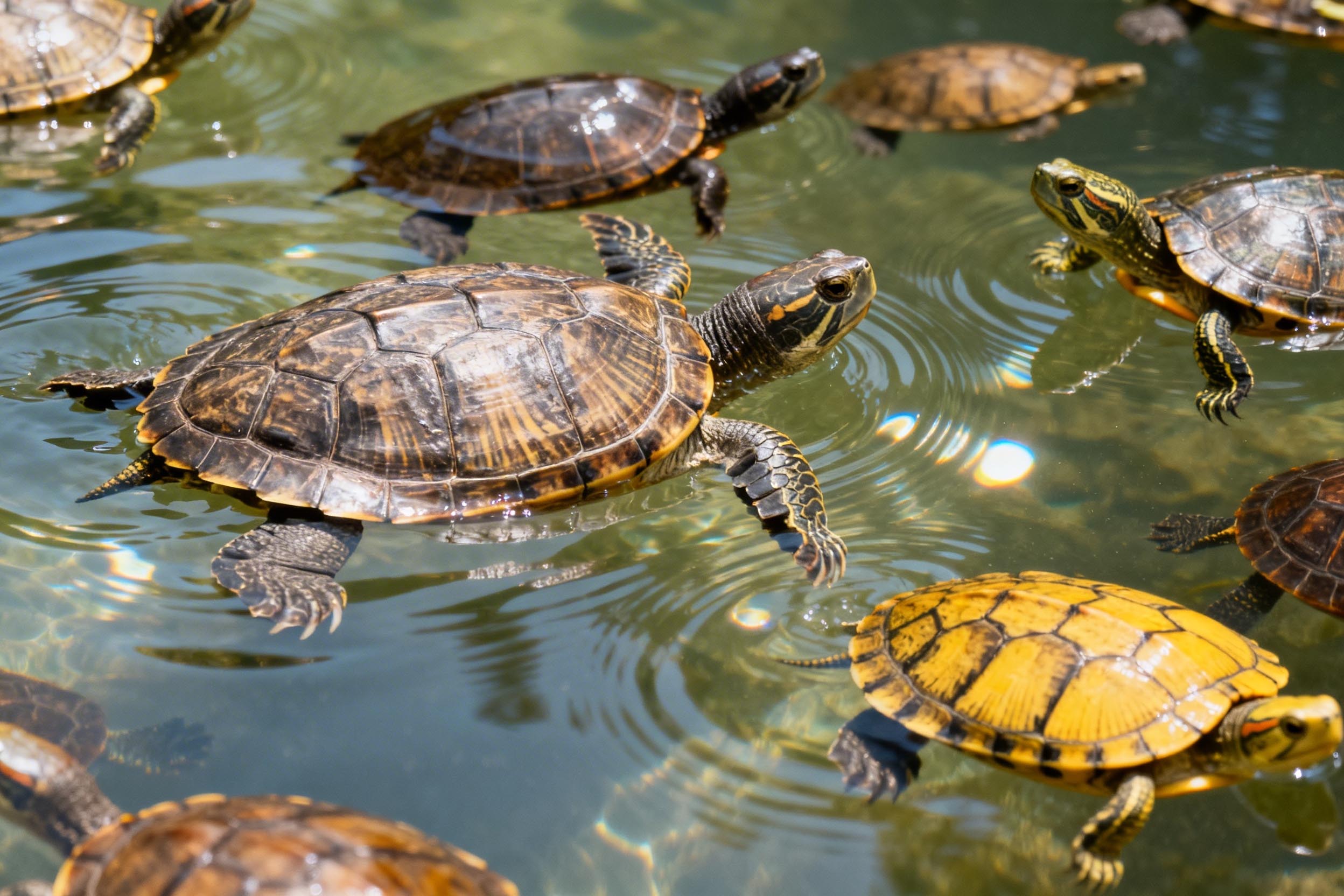
One of the most common mistakes new turtle keepers make is buying a hatchling without realizing how big it will grow. A red-eared slider the size of a coin becomes a 12-inch adult that needs a 100-gallon tank. For keepers with limited space, that is a problem.
The solution is to choose a species that stays small for life. These turtles reach their adult size within a few years and never outgrow their enclosure. Here are 8 of the best options.
Comparison Table
| Species | Adult Size | Min. Tank | Difficulty |
|---|---|---|---|
| Musk turtle | 3–5 in (8–13 cm) | 20–40 gal | Easy |
| Mud turtle | 3–5 in (8–13 cm) | 20–40 gal | Easy |
| Chinese pond turtle | 6–8 in (15–20 cm) | 40–55 gal | Moderate |
| Spotted turtle | 4–5 in (10–13 cm) | 30–40 gal | Moderate |
| Reeves' turtle | 5–8 in (13–20 cm) | 40–55 gal | Moderate |
| Southern painted turtle | 4–6 in (10–15 cm) | 30–40 gal | Easy |
| Stinkpot (common musk) | 3–5 in (8–13 cm) | 20–40 gal | Easy |
| Three-striped mud turtle | 4–5 in (10–13 cm) | 30–40 gal | Moderate |
1. Musk Turtle (Stinkpot)
Sternotherus odoratus
The musk turtle is the most popular small turtle for good reason. Adults reach only 3 to 5 inches, making them ideal for apartment keepers. They are hardy, long-lived (30–50 years), and do well in a 20 to 40-gallon tank.
Care highlights: water depth of 6–12 inches, basking platform, UVB lighting, filter rated for 2x tank volume. They walk along the bottom rather than swimming, so more floor space matters more than depth. See our full musk turtle care guide.
2. Mud Turtle
Kinosternon species
Mud turtles are close relatives of musk turtles and stay similarly small — typically 3 to 5 inches. They are bottom-dwellers that prefer shallow water and plenty of places to hide. The eastern mud turtle and the three-striped mud turtle are the most commonly kept species.
Care highlights: shallow water (4–8 inches), soft substrate for burrowing, UVB lighting, and stable warm temperatures. They are hardy but appreciate a well-planted tank with lots of cover.
3. Chinese Pond Turtle
Mauremys reevesii
Also known as the Reeves' turtle or the Chinese three-keeled pond turtle, this species reaches 5 to 8 inches as an adult. Males stay smaller than females and often turn almost completely black as they mature. They are hardy, interactive, and do well in a 40 to 55-gallon tank.
Care highlights: good filtration, basking platform, UVB lighting. They are more sensitive to water quality than musk turtles and need consistent cleaning. See our Chinese pond turtle care guide (coming soon).
4. Spotted Turtle
Clemmys guttata
Spotted turtles are one of the most attractive small species, with bright yellow spots on a black shell. They reach only 4 to 5 inches as adults. However, they are protected in many areas and can be difficult to acquire legally. They also have specific habitat needs and are not recommended for beginners.
Care highlights: shallow, planted water with a soft substrate for burrowing, a land area for foraging, and cool temperatures. They are sensitive to water quality and stress.
5. Reeves' Turtle
Mauremys reevesii
The Reeves' turtle (also called the Chinese pond turtle) is technically the same species listed above, but because there is so much confusion in the trade about names, it is worth its own entry. Males reach only 5 to 6 inches, females 7 to 8 inches. They are hardy and adaptable.
Care highlights: good filtration, basking area, UVB lighting, and a varied diet. Males can be aggressive toward each other, so keep them separately or in a very large tank.
Other Small Species
Southern painted turtle (Chrysemys dorsalis) — reaches 4 to 6 inches, similar care to other painted turtles, but smaller. A good option for keepers who want the classic painted turtle look in a smaller package.
Three-striped mud turtle (Kinosternon baurii) — reaches 4 to 5 inches, similar care to the musk turtle. Hardy and long-lived.
Red-cheeked mud turtle (Kinosternon scorpioides cruentatum) — a smaller mud turtle from Central and South America, reaches 4 to 5 inches. Needs warmer water than North American mud turtles.
Common snapping turtle — not recommended. Hatchlings are small and cute, but they grow to 40+ pounds and are aggressive. This is one of the most commonly abandoned pet turtles in the world.
Frequently Asked Questions
What is the smallest pet turtle?
The smallest commonly kept pet turtle is the musk turtle (Sternotherus odoratus), which reaches only 3 to 5 inches (8 to 13 cm) as an adult. Other small species include the mud turtle, the Chinese pond turtle (males stay smaller), and the spotted turtle.
How big of a tank does a small turtle need?
A single small turtle like a musk turtle can live comfortably in a 20 to 40-gallon tank. Even small turtles need swimming space, a basking area, and a filter rated for twice the tank volume. Do not be tempted by tiny tanks marketed for "small turtles" — they are inadequate for long-term care.
Do small turtles stay small their whole life?
Yes. Species that stay small reach their adult size within 3 to 5 years and do not continue growing. A musk turtle that is 4 inches at age 5 will remain roughly that size for the rest of its life. This makes small species ideal for keepers who cannot accommodate a large tank.
What is the best small turtle for beginners?
The musk turtle is the best small turtle for beginners. It is hardy, long-lived, stays under 5 inches, and does well in a 20 to 40-gallon tank. It is more tolerant of beginner mistakes than many other small species.
Are small turtles easier to care for?
Not necessarily. Small turtles need the same UVB lighting, filtration, and temperature control as large turtles. Their smaller tank size makes water changes easier, but they still require the same level of attention and equipment. The main advantage of a small turtle is space, not ease of care.
Final Thoughts
If you are short on space but want a turtle, small species are the answer. The musk turtle and mud turtle are the two best choices for most keepers — they stay small, are hardy, and can live comfortably in a 20 to 40-gallon tank.
Whatever species you choose, remember that "small" does not mean "low maintenance." All turtles need UVB, filtration, and proper temperature control. Plan the setup before you buy the animal.
Sources & References
- Ernst, C. H., & Lovich, J. E. (2009). Turtles of the United States and Canada (2nd ed.). Johns Hopkins University Press.
- Bonin, F., Devaux, B., & Dupré, A. (2006). Turtles of the World. Johns Hopkins University Press.
- Merck Veterinary Manual. Management and Husbandry of Reptiles. Retrieved 2026.
- Association of Reptilian and Amphibian Veterinarians (ARAV). Care sheets for common pet chelonians. Retrieved 2026.